
The Next Fintech Wave Isn't Fintech — It's the Power Grid
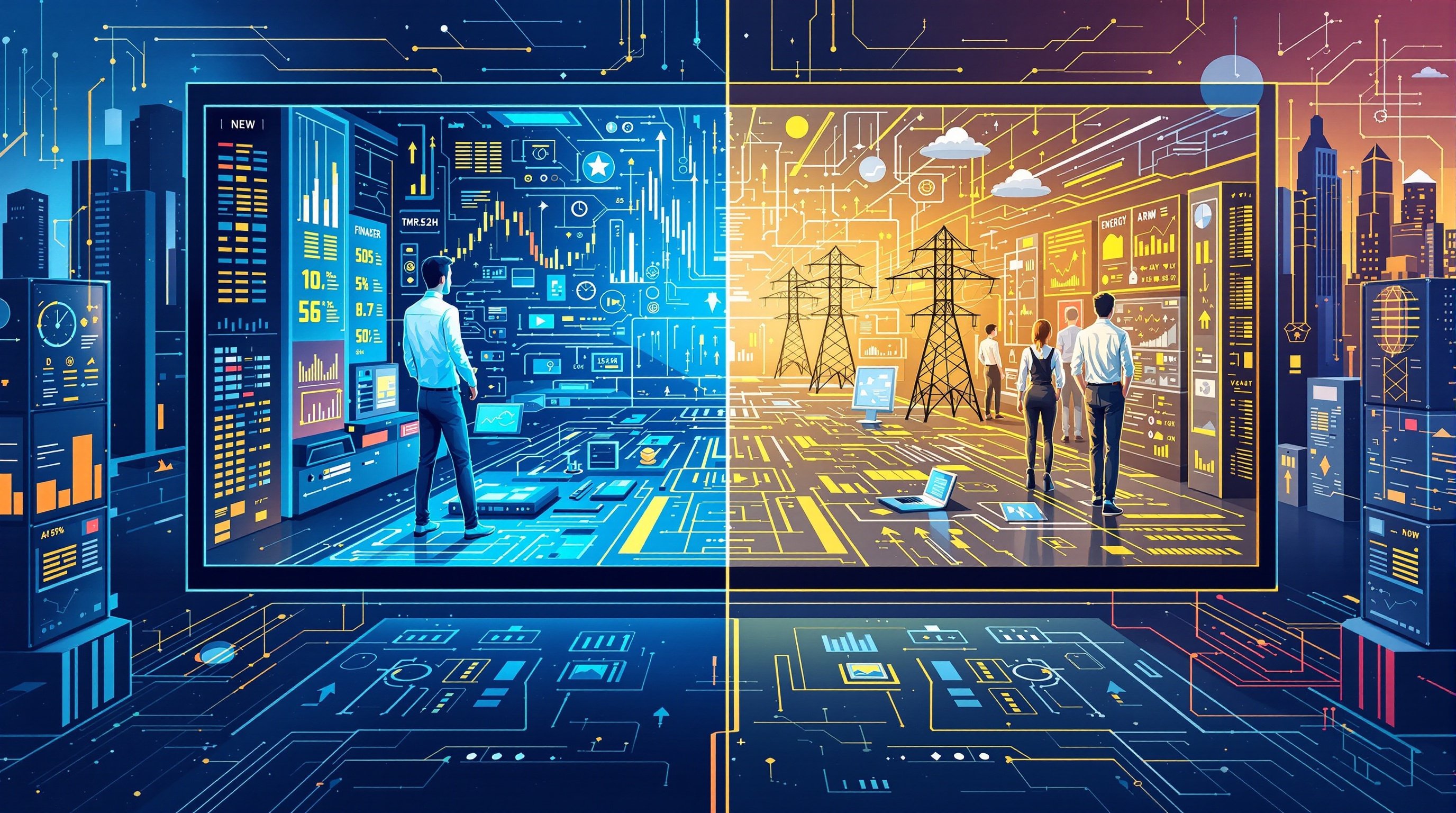
The Next Fintech Wave Isn’t Fintech — It’s the Power Grid
(How the Largest Financial Market in History Is Being Built Right Now, in Plain Sight)
TL;DR – Read this first, then read everything else
- Over the last ten posts we walked the entire path:
- Pure energy SaaS died quietly
- 2–3. Bitcoin miners invented proof-of-curtailment and turned “off” into the highest-margin product in electricity
- 4–5. 200 GW of batteries + 1 M+ Powerwalls are already printing 4–20× returns using the same primitive
- 6–7. The old renewable deal (PPAs + RECs) is dead; hyperscalers will now pay any price for synthetic firm tokens
- The seven-layer grid balance-sheet company does not yet exist at scale
- 9–10. Fintech built the perfect mirror (KYA/VTS/agentic rails) and the two worlds are already colliding in 2025 pilots
- The collision creates the first true electron-backed money — a token that is simultaneously currency, compliance proof, and physical grid capacity.
- The company that owns the merge layer will capture 25–50 % of the entire $10–20 trillion energy-transition cash flow.
- That company has not been crowned yet.
- If you are reading this in late 2025, you are still stupidly, almost unfairly early.
The One Primitive That Changed Everything
It all starts with a single receipt.
When a Bitcoin miner, a Powerwall, or a grid-scale battery voluntarily reduces load (or injects power) at the exact moment the grid screams for help, it creates a cryptographically signed log:
Timestamp Device ID Action Grid Signal Value Created 2025-08-14 15:32:11 Rig-47291 –300 MW ERCOT Emergency $1,800/MWh paid 2025-11-02 19:04:07 Powerwall-8F3A1 +13.5 kWh CAISO Flex Alert $2/kWh credit That log is the new gold.
It is simultaneously:
- Payment receipt (grid pays you)
- Compliance proof (24/7 carbon-free)
- Collateral (banks lend against it)
- Token (secondary market trades it)
We spent three entire posts (Pieces 3, 5, 7) proving this primitive already exists at scale in 2025.
The Full Business Model — The Seven-Layer Grid Balance-Sheet Company
Layer 2025 Fragmented Owner 2032 Integrated Owner Margin Capture 1 Physical control Tesla / Jupiter GridCo 8–12 % 2 Dispatch engine Habitat / Autobidder GridCo 10–15 % 3 Principal trading book Almost nobody GridCo 20–40 % 4 Collateral & credit BlackRock mezz GridCo 5–10 % 5 Token mint Iris / Tesla pilots GridCo 15–30 % 6 Reinsurance layer Munich Re pilots GridCo 5–12 % 7 Customer relationship Google / Microsoft GridCo 20–35 % The integrated company keeps 70–85 % of the gross margin forever.
Cash-flow waterfall at maturity (1 GW portfolio, 2030 prices):
Gross revenue per MWh → $400–$600
Hardware owner gets → $60
Optimiser gets → $40
GridCo keeps → $300–$500
That is $2.2–$3.6 billion annual profit on one gigawatt.
The Mirror and the Merge
Fintech spent fifteen years doing exactly the same thing with dollars that the grid is now doing with electrons.
Fintech 2025 Grid 2025 Collision Product 2030 KYA (agent identity) Powerwall/rig identity Agent-controlled battery fleets VTS (verified trust stack) Curtailment log → token Electron-backed stable asset x402 session keys Miner signing keys Real-time grid bidding by agents Stripe Issuance receipts Synthetic firm certificates Money that is also green proof The 2025 pilots are already live:
- Project Ohm (Tesla + Coinbase + Iris)
- Project Volt (Stripe + Jupiter)
- Project Ampere (Google + Hut 8)
They are not experiments.
They are the first bricks of the new monetary system.
The Margin Flywheel in One Diagram
Logs → Tokens → Collateral → Cheaper Debt → More Assets → More Logs↑ ↓ Reinsurance Agentic Rails (KYA/VTS) insurance (Stripe/Coinbase)
This loop is already spinning at small scale.
At planetary scale it becomes the new global settlement layer.
Who Wins, Who Dies
Category Fate Pure hardware makers Commodity margins Pure SaaS optimisers Acquired or irrelevant Traditional utilities Regulated to death Traditional banks Can’t move at electron speed Bitcoin miners First-mover advantage, but limited scale Hyperscalers Captive buyers — pay any price The Grid Balance-Sheet Company Winner takes most Market cap range by 2040: $1–4 trillion (larger than JPMorgan + Exxon combined).
Final Thought — You Are Early
If you started reading this series in 2025:
- Proof-of-curtailment was still a niche miner trick
- KYA and VTS were VC memes
- Synthetic firm power was a $200/MWh experiment
- The seven-layer company did not exist
By the time most people notice, the flywheel will already be spinning at terawatt scale.
The electrons are moving.
The money is just starting to follow.
Get long the grid balance sheet.
You now know exactly how it ends.
Key Takeaways (the entire series in seven bullets)
- Pure software failed in energy because only capital eats risk.
- Bitcoin miners accidentally invented proof-of-curtailment — the primitive that turns “off” into money.
- 200 GW of batteries + millions of Powerwalls are already 4–20× mispriced.
- RECs died in 2025; hyperscalers now pay 5–8× for synthetic firm tokens built from the same logs.
- The grid balance-sheet company owns all seven layers and keeps 70–85 % margin.
- Fintech built the perfect mirror (KYA/VTS/agentic rails) and the collision is already in pilot.
- The winner will be the most valuable company ever built on physical infrastructure.
Thank you for reading the whole series.
If one person builds the company because of it, it was worth every word.
The grid is the new balance sheet.
Time to get long.