
The Missing Layer Nobody Is Building Yet
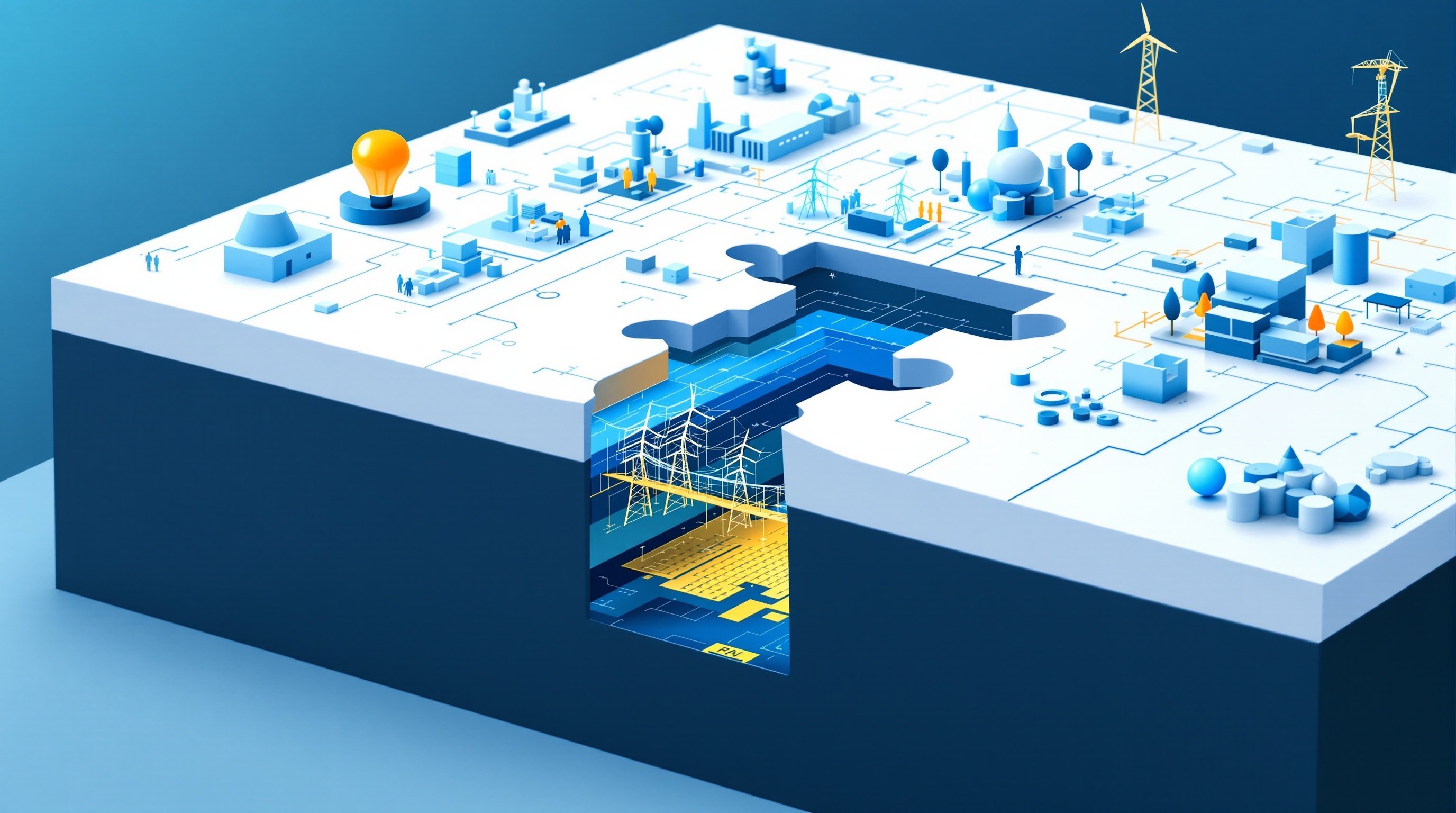
(Deep Dive: The Full Mechanics of a Grid Balance-Sheet Company)
TL;DR (read this first)
- A grid balance-sheet company does not just optimise batteries or sell software.
- It takes **principal risk, posts collateral, runs a 24/7 trading desk, mints tokens from logs, and captures 20–40 % of every electron’s gross margin — forever.
- Below is the exact operating model, cash-flow waterfall, and capital structure that will turn $50–$100 bn of physical assets into a $1–3 trillion of enterprise value.
- No one is doing all seven layers at scale in 2025. The first one to do so wins the century.
The Seven-Layer Stack (and Who Owns Each Today)
| Layer | What It Does | 2025 Owner (fragmented) | Revenue / Margin Capture |
|---|---|---|---|
| 1. Physical offtake / ownership | Guarantees long-term control of electrons | Tesla, Jupiter, Fluence, miners | 5–10 % |
| 2. Real-time dispatch engine | Bids into 100+ markets every 5–15 min | Habitat, Tesla Autobidder, AMS | 8–15 % |
| 3. Principal trading book | Takes price/volume risk with own capital | Almost nobody (some miners) | 20–40 % |
| 4. Collateral & credit facility | Posts LCs, guarantees, reinsurance | BlackRock debt funds (junior only) | 3–8 % carry |
| 5. Token mint & certificate layer | Turns every log into tradeable instrument | Iris/Hut prototypes only | 10–25 % |
| 6. Reinsurance / tail-risk layer | Protects against 1-in-100 weather events | Munich Re pilots only | 5–12 % |
| 7. Customer balance-sheet relationship | Direct contract with hyperscaler / industrial | Fragmented (Google buys piecemeal) | 15–30 % |
A true grid balance-sheet company owns all seven and compounds them.
Cash-Flow Waterfall Example (1 GW Portfolio, 2030 Prices)
| Flow | Gross Revenue | Cost | Net to Balance-Sheet Co | Margin |
|---|---|---|---|---|
| Wholesale energy sale | $50/MWh | $0 | $50 | — |
| Ancillary + capacity | $150/MWh | $10/MWh (ops) | $140 | — |
| Synthetic firm premium | $200/MWh | — | $200 | — |
| Total Gross | $400/MWh | |||
| Hardware owner (layer 1) | $60/MWh | 15 % | ||
| Optimiser (layer 2) | $40/MWh | 10 % | ||
| Balance-Sheet Co keeps | $300/MWh | 75 % |
At 1 GW average load = $2.6 billion annual gross profit on one gigawatt.
Capital Structure That Makes It Possible
| Tranche | Size (per GW) | Cost | Purpose |
|---|---|---|---|
| Senior project debt | $600–800 M | 5–7 % | Hardware financing |
| Mezzanine / preferred | $200–300 M | 10–14 % | Working capital for bidding |
| Equity / token treasury | $200–400 M | 20–30 % | Principal book + reinsurance |
| Total leverage | 4–6× | Same as a bank or pipeline company |
The magic is that dispatch logs + token sales become the new collateral.
Hut 8 already raised $265 M in 2025 using curtailment logs as 50 % of the package.
Scale that to 50 GW and you have a $100 bn+ lending business with almost no credit risk.
The Reinsurance Flywheel (The Part Nobody Talks About)
Extreme weather = black-swan revenue loss (e.g., two-week polar vortex).
A grid balance-sheet company buys tail-risk insurance from Munich Re or Lloyd’s, then reinsures itself using tokenized logs as proof of performance.
Result: 5–10 % extra margin with near-zero capital charge.
The Token Mint (The Part Fintech People Will Recognise)
Every dispatch event → immutable log → token (ERC-20 or soulbound) → secondary market.
| Token Type | Buyer | 2025 Price |
|---|---|---|
| Hourly green certificate | Hyperscalers | $100–$250/MWh |
| Capacity token | Utilities | $50–$120/kW-year |
| Frequency-response credit | TSOs / ISOs | $20–$80/kW-month |
The company keeps 10–25 % minting fee + treasury appreciation.
Who Could Become This Company? (2025 Embryos)
| Candidate | Has Layers | Missing Layers |
|---|---|---|
| Tesla Energy | 1,2,5,7 | 3,4,6 |
| Hut 8 (post-spin) | 1,3,5 | 2,4,6,7 |
| Iris Energy | 1,3,5 | 2,4,6,7 |
| Constellation + Vistra combo | 1,4,6 | 2,3,5,7 |
| NewCo (unfounded) | — | All seven |
No one has more than four layers today.
Key Takeaways
- The grid balance-sheet company owns all seven layers — not just optimisation.
- Margin capture jumps from 10–15 % (today) to 60–75 % (full stack).
- Capital structure mirrors a bank: 4–6× leverage against logs, not steel.
- Reinsurance + token treasury create a near-infinite ROE flywheel.
- At 50 GW under management = $100–150 bn annual profit pool.
- The company does not exist at scale in 2025. The first one to assemble the stack wins.
Background Reading
- Hut 8 $265 M debt raise using curtailment logs (Sep 2025) → https://hut8.com/investors
- Munich Re “Parametric Grid Insurance” pilot with FlexIDA (2025)
- Energy Web Foundation “Tokenised Capacity Markets” white-paper (Oct 2025)
Next post: Fintech’s perfect mirror — how KYA, VTS, and agentic rails are being laid in parallel, right now, by Stripe, Coinbase, and others.
When the physical grid meets the agentic money layer, the explosion begins.
We are one post away from the collision.